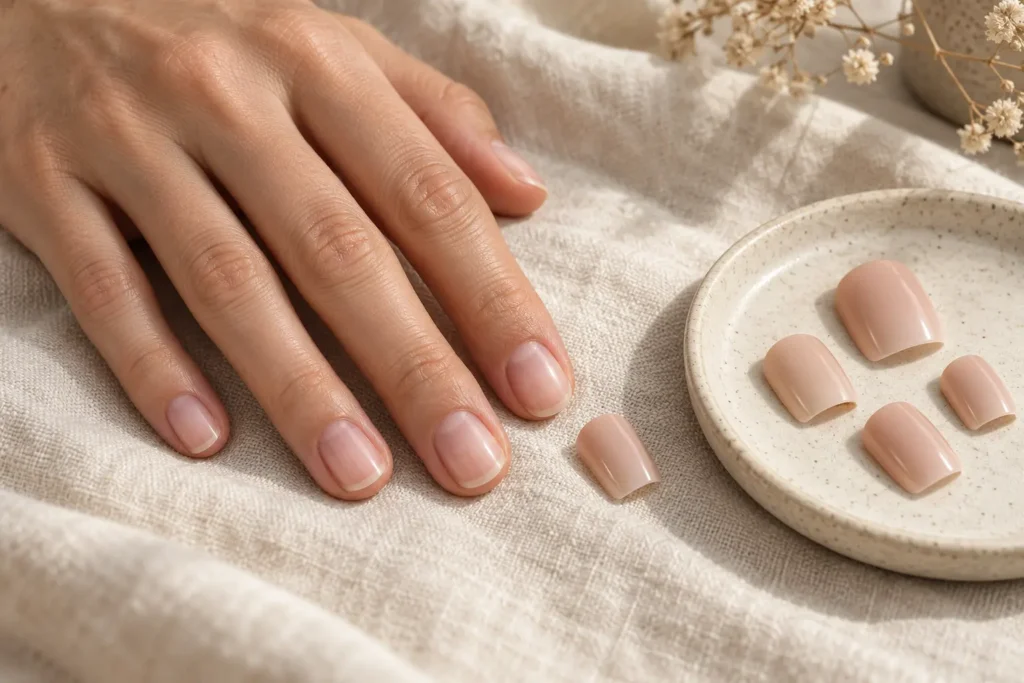
Nails · Style guide
Press-On Nail Sizes: A Fit Check Before You Open the Glue
Find a better press-on fit with checks for width, curve, base, contact and length. Make a reusable size map for both hands before applying…
Explore the guide ↗Compare round, squoval, square and oval shapes for short nails, with a clear outline chart, practical length checks and a useful salon brief.
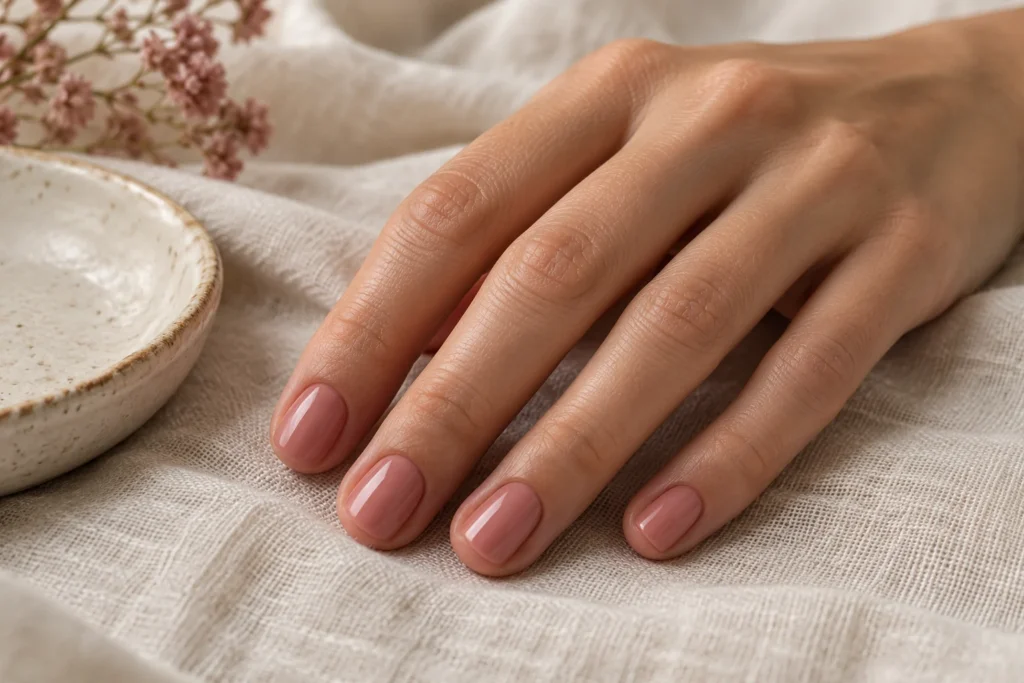
For short natural nails, round and squoval are useful starting points. Round gives you a curved tip; squoval keeps a flatter centre with softened corners. A short square shape is another option if you like a defined edge. Oval needs enough free edge to create a longer curve, so it may be less distinct on nails trimmed close to the fingertip.
Choose from the nail length you actually want to wear, rather than the shape name on a long-extension photograph. You can keep a short manicure deliberate and polished without narrowing every nail into a point.
The nail bed is the area beneath the attached nail. The free edge is the part extending beyond the fingertip. You may have a long-looking nail bed with almost no free edge, or a shorter-looking bed with some length available for shaping.
That distinction matters when you bring a reference to an appointment. Filing can change the outline of available nail; it cannot create missing length or change the size of your nail bed. Ask to see the proposed shape at your current length before discussing extensions.
Look at your hand with the fingers relaxed. Decide whether you prefer a continuously curved end or a straighter line across the tip. This simple choice is more useful than trying to match a shape to a supposed “correct” type of hand.
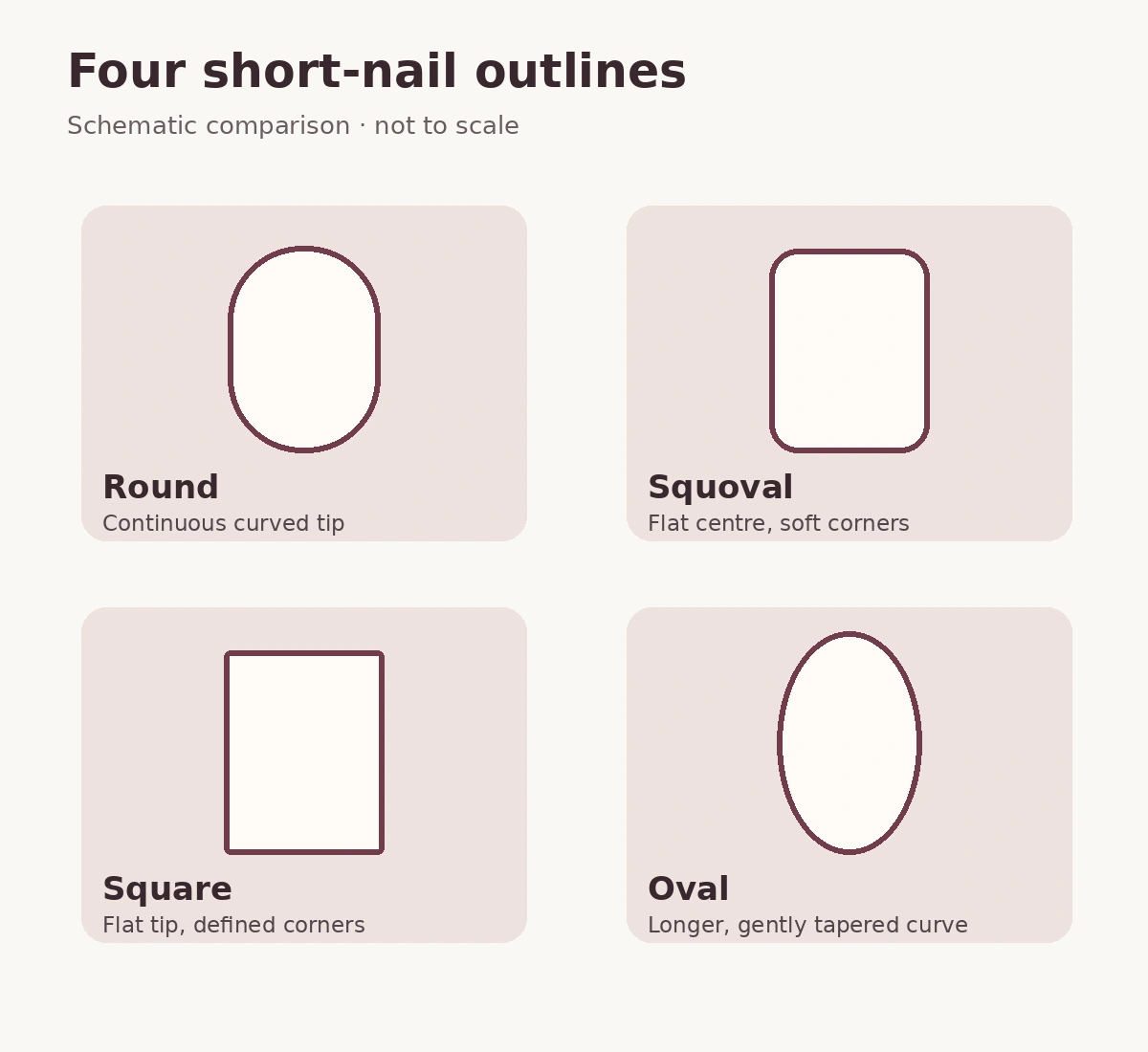
| Shape | What to look for | A useful choice when… |
|---|---|---|
| Round | A curved free edge without distinct corners | You want a soft outline with little spare length. |
| Squoval | A fairly flat centre with rounded corners | You like the neatness of square nails but prefer softer edges. |
| Square | A straight tip and more defined corners | You enjoy a crisp outline and have enough edge to show it. |
| Oval | A longer curve with a gentler taper towards the tip | There is enough free edge to show an elongated outline. |
These names describe outlines, not a promise about durability. Sally Beauty’s nail-shape guide describes the differences between round, square, squoval and oval outlines. Your own nail condition and preferred length still matter.
A round shape follows a continuous curve across the tip. On a very short nail, it can be a small adjustment rather than a dramatic semicircle. Tell your stylist whether you want to keep the existing width instead of asking for a narrower shape by default.
Compare it with a square reference in the same colour. A pale sheer polish can make the outline harder to judge in a bright photograph, while a darker colour makes the edge easier to see. Choose the silhouette you like rather than assuming that short nails must look a particular way.
Squoval sits between square and round. The tip keeps a straighter central area, and the corners are softened. If a previous manicure felt too round, ask to preserve more of that flat centre; if it felt too angular, show which corners you want softened.
The distinction can be subtle at a short length. A useful request is “keep the middle fairly straight and soften only the corners”, rather than repeatedly filing until the shape resembles a much longer reference.
Square creates a clear line across the free edge. Before choosing it, notice whether you enjoy seeing the corners or would prefer them less pronounced. There is room for preference here: a neat square outline does not need to imitate the width or length of an extension set.
If the reference has broad French tips, separate that design choice from the shape. You can ask for a short square manicure with a narrow tip, or for solid colour, without reproducing every proportion in the photograph.
Oval looks more elongated than a compact round outline. The curve needs space to develop. If your nails end close to the fingertip, ask whether a short round version would express the same soft finish while keeping the length you want.
Avoid treating “oval” as an instruction to keep narrowing the sides. If the desired outline is not possible at your chosen length, agree on a modest version now or discuss what added length would involve. Extensions are an option, not a requirement for a finished-looking manicure.
Consider your normal week before deciding on the edge. Do you handle fine knitwear, put on contact lenses, play an instrument or spend much of the day typing? The point is to describe the length and corners you find manageable, not to assume one shape works for every activity.
For example, if you like the appearance of square nails but dislike a noticeable corner against fabric, ask to compare a softer corner while keeping the centre straight. If you prefer a rounded finish but want it to feel less circular, check whether there is enough free edge for a modest oval.
You do not need to describe your fingers as too wide, too short or in need of correction. A shape can be a styling preference. Keep a reference because you like its outline, colour or detail, and say which of those features matters to you.
For routine fingernail trimming, the American Academy of Dermatology recommends cutting almost straight across, then slightly rounding the corners. It also recommends smoothing rough edges with a file, working in one direction and leaving cuticles alone.
If you are maintaining a salon shape, aim to smooth a small snag or keep the existing outline rather than create a new shape in one sitting. Pause frequently and compare both sides in good light. Stop rather than filing into the skin or thinning the sides to force a pointed reference.
A damaged or painful nail is not a styling challenge to file away. For an unfamiliar enhancement, ask the person who applied it how the shape should be maintained and removed. If you notice an unexplained change in nail colour, texture or shape, seek advice from a qualified dermatologist rather than relying on a manicure guide.
Bring one photograph for the outline and, if necessary, a second for the colour. A close view of the nail tips is more helpful for shape than a hand photographed at an angle that hides the free edge.
Before the colour goes on, look at the shape with your hand relaxed and from the side. If you are unsure, point to the specific nail or corner rather than changing the whole brief. Natural nails may differ slightly; discuss whether you want a similar visible length or a similar outline across the set.
Once the outline is settled, choose the amount of artwork. A narrow tip, a small crescent or one accent nail can leave the main colour visible on a short surface. A detailed reference may need fewer lines, not a longer nail.
Our burgundy nail designs with chrome and gold include fine tips and cuticle accents to compare. If you prefer a finish rather than painted motifs, explore the short squoval option in our dark red cat-eye nail guide. For small character details, the Halloween nail ideas show ghosts, pumpkins and corner webs with short-nail adaptations.
Treat these as design references. The same colour or motif can be adjusted to a different outline, and a seasonal design does not require you to change the way you normally wear your nails.
An almond outline needs room for a visible taper and rounded point. On a very short natural nail, that reference may not translate without extra length. Ask which part of the look you like: a soft tip may be possible as a compact round shape even when the full almond silhouette is not.
No. Squoval retains a straighter area across the tip and softens its corners. Oval forms a more continuous elongated curve. If the names are confusing, show a close reference and describe whether you want to keep that flat centre.
Decide what consistency means to you. You may prefer a similar visible free edge or a coordinated outline while keeping a shorter nail comfortable. If one nail has broken, ask about a temporary compromise rather than assuming that every nail must be cut to match it.
For your next appointment, take a short brief you can repeat: current length, preferred edge, one colour and the detail you want to notice first. That gives you a clear starting point and makes any change at the next visit easier to explain.
Zaki is a professional hairstylist and Rafaa is a professional nail stylist. Explore our guides for styling ideas, practical steps and details to help you choose your next look.
Meet the team · Editorial & image policy · Suggest a correction
Find a better press-on fit with checks for width, curve, base, contact and length. Make a reusable size map for both hands before applying…
Explore the guide ↗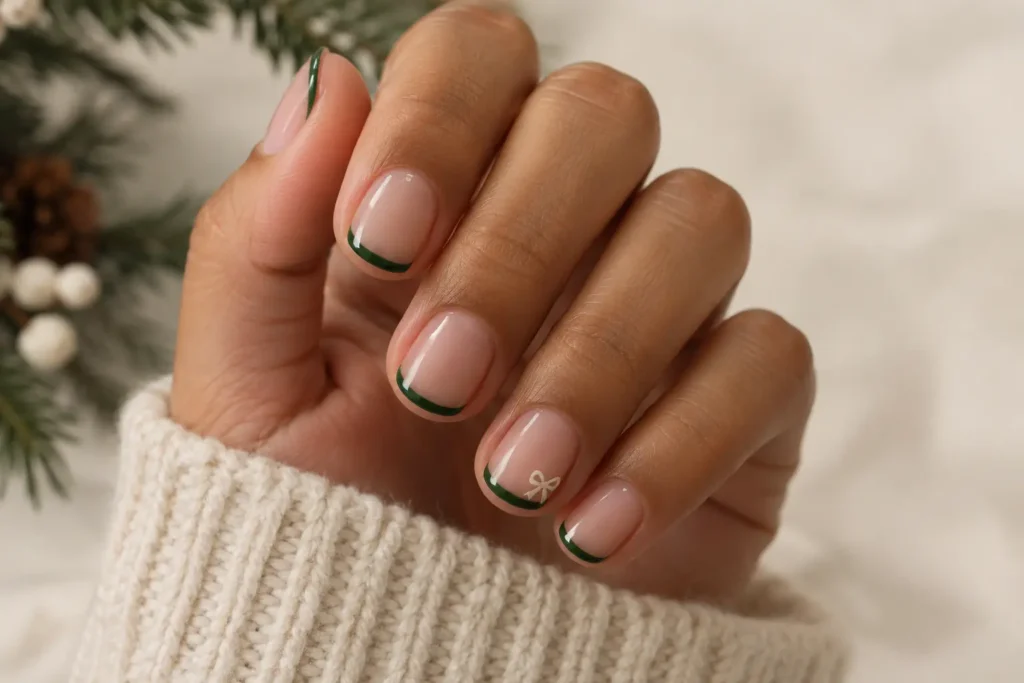
Plan Christmas nail art for a short canvas. Compare edge, corner and base placement, with ways to simplify tips, bows and tiny details without…
Explore the guide ↗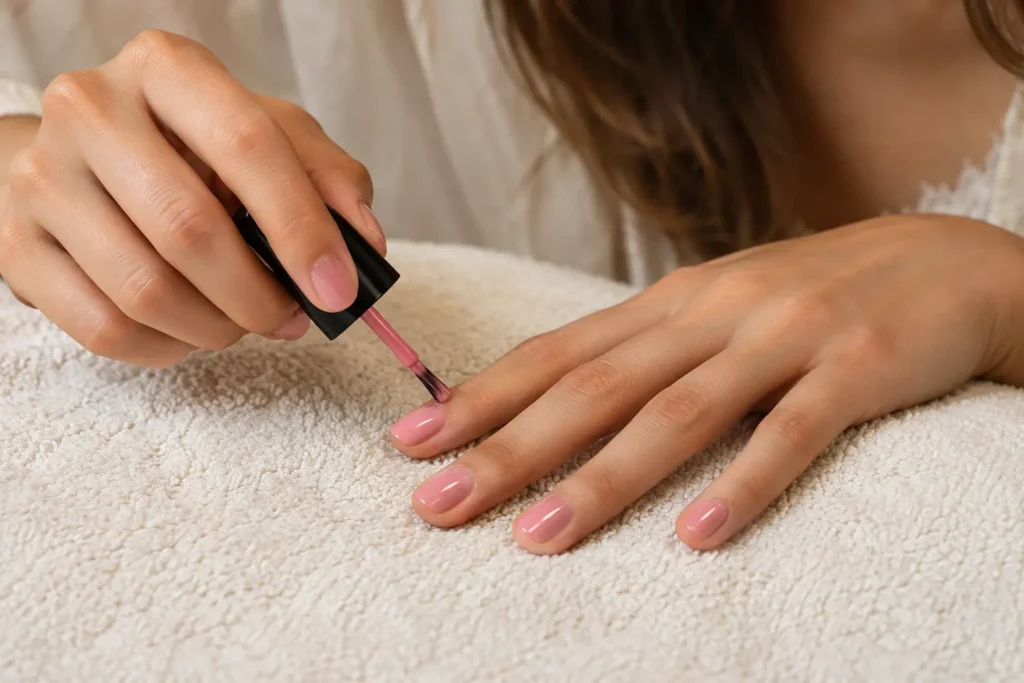
Learn a controlled regular-polish routine, practise on one hand and troubleshoot flooding, streaks and smudges without relying on universal drying times.
Explore the guide ↗